
Participatory Urban Rewilding Through Behavior-Centred Tools & Systems
Rewild and Repeat
Overview
Problem
Participation friction blocks ecological action
Urban biodiversity solutions like living walls and green systems are expert-led, infrastructure-heavy, and difficult for everyday citizens to install — creating a gap between environmental intention and real participation.
Approach
Research → insight → intervention system
I conducted expert interviews, system comparisons, and prototype testing to identify participation barriers, then designed low-skill, modular rewilding tools and service concepts that enable repeatable citizen action.
Outcome
Tools + service + participation model
A modular urban rewilding system combining attachable planting pockets, seed-dispensing tools, and a concept mapping platform that turns ecological contribution into a simple, repeatable civic behavior.
Problem Context
Urban residents are increasingly aware of biodiversity loss and climate impact, but lack accessible and practical ways to contribute to ecosystem regeneration in dense city environments. Most urban greening systems — such as living walls and vertical gardens — require specialist installation, irrigation infrastructure, and technical expertise, limiting participation to institutions rather than citizens.
This creates a participation gap: ecological action is seen as valuable but not personally doable.
The project explores how native wildflowers can be used to regenerate a city’s ecosystem through citizen-led, low-skill, distributed interventions.

Research Questions
-
What prevents citizens from participating in small-scale urban rewilding?
-
Which planting actions feel accessible versus technical?
-
How can ecological contribution be made low-risk and repeatable?
-
What installation and maintenance barriers block adoption?
-
How might participatory planting scale across city infrastructure?
Methods Used:
Expert interviews with ecologists, biodiversity researchers, and conservation scientists
Concept review documents sent to domain experts for technical validation
Comparative analysis of existing vertical garden and living wall systems
Material and mechanism prototyping
Controlled prototype testing (moisture retention, germination, soil stability)
Assumption testing of citizen-installable planting systems
Scenario modelling of public participation formats
Service concept prototyping (mapping + trails)
Expert Research and Validation


.png)

Expert Consultation Included
-
Forest research specialists
-
Biodiversity and conservation scientists
-
Plant ecology researchers
-
Green wall system experts
Experts advised on:
-
species selection constraints
-
moisture & drainage risks
-
vertical planting limitations
-
germination requirements
-
structural safety concerns
-
citizen science integration opportunities
Feasibility Constraint
Experts confirmed that vertical planting systems typically fail at the moisture and drainage layer — making water management the critical design constraint.
Installation Risk
Green wall specialists emphasized that drilling, irrigation, and waterproofing requirements are the main barriers preventing citizen-led installation.
Species & Site Matching
Ecology researchers advised that plant success depends heavily on micro-site conditions, reinforcing the need for modular and adaptable planting units.
Participation Safety
Conservation experts stressed that citizen rewilding tools must minimize ecological harm risk through guided use and species selection clarity.
Modular Advantage
Expert feedback supported modular pocket systems over fixed tile systems due to easier installation, maintenance, and replacement.
Citizen Science Opportunity
Researchers encouraged integrating lightweight citizen data collection to map bloom success and pollinator activity across locations.
Prototype Direction Shift
Expert and prototype feedback together led to shifting from hydrogel tile systems toward felt pocket modules with passive moisture retention.
Key Insights
1. Installation friction blocks participation:
Most existing green wall systems require drilling, frames, irrigation, and waterproofing — beyond citizen comfort levels.
2. Ecological action feels risky when outcomes are uncertain:
Participants hesitate when unsure whether planting is “correct” or sustainable.
3. Moisture management is the critical failure point:
Hydration systems failed more often than structural systems in early prototypes.
4. Smaller modular units reduce psychological and physical barrier:
Pocket-scale systems were faster to install and test than tile systems.
5. Visible growth creates rapid motivation loops:
Pocket system germination within 4 days increased perceived success vs expected 7–14 days.
From Research to Insight
To translate field research and expert input into design direction, I synthesized findings into recurring behavioral and ecological themes. Rather than designing for ideal planting conditions, I focused on real-world participation barriers and motivation triggers.
Participation drops when planting requires tools, permissions, or specialist knowledge
Residents expressed interest in supporting biodiversity but disengaged when actions felt technical or regulated.
Design implication:
Interventions must be tool-light and immediately usable.
People prefer reversible and non-destructive planting methods in public spaces
Concerns around property damage and legality reduced willingness to act.
Design implication:
Solutions should appear modular, temporary, and low-risk.
Motivation is highest at the moment of discovery, not later planning
Interest often did not translate into delayed action.
Design implication:
Tools must support immediate deployment.
Ecological success depends on native species match, not planting density alone
Expert interviews emphasized resilience over volume.
Design implication:
Seed selection and delivery precision matter more than quantity.
Concept Exploration Tracks


Track A — Modular Wildflower Pocket Chain System
Citizen-installable felt pocket modules attach to varied city structures without drilling.
Track B — Interactive Seed Roller System
Rolling seed tools enable participatory street-level planting and pattern creation.
Both systems emphasize:
-
low skill
-
repeatable action
-
visible participation
-
distributed ecological impact
Concept Evaluation Criteria
-
participation barrier level
-
cost and repeatability
-
skill required
-
surface flexibility
-
ecological suitability
Key Tradeoffs
-
Ecological density vs. public usability
-
Permanence vs. reversibility
-
Specialist precision vs. citizen accessibility
Decision
I prioritized repeatable public participation over maximum planting density. Scaled participation produces broader biodiversity impact than isolated expert interventions.
Prototype Testing Findings
Prototype Comparison Results
Pocket chain system vs soil/water tile system:
-
faster setup time
-
better moisture retention (3 days without watering)
-
higher germination success
-
greater soil stability
-
fewer assembly materials required
-
lower failure rate
Tile system failed due to hydrogel water transfer limitations.


Final System — Multi-Component Participation Model


-
modular felt planting pockets
-
rolling seed spreader tools
-
replaceable seed cartridges
-
multi-surface attachment mechanisms




Service & System Design Layer
Service System Components
-
public tool stands in streets
-
community planting events
-
citizen science data contribution
-
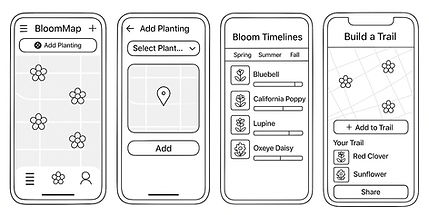
seasonal bloom trail mapping
-
distributed stewardship model
-
modular refilling & reseeding flow
Tool stand
Citizen picks tool
Installs pocket
Scans QR
Map updates
The service layer connects citizens, events, and data flows through community stewardship, tool stands, and participatory mapping — making ecological action visible and repeatable.
Content & Communication Design
Role of content
Content was used to guide participation and lower the barrier to urban planting, helping users understand where, how, and why to plant.
Key principles
-
Simple, action-led instructions
-
Encouraging participation over perfection
-
Clear environmental impact messaging
Content constraints
-
Must be understood in under 3 seconds
-
Designed for outdoor / public environments
-
Accessible to non-expert users
-
Limited space (physical signage + mobile UI)
Iteration example
Early phrasing explored more descriptive instructions:
“Use the roller to plant seeds across soil surfaces.”
This was simplified to:
“Roll, plant, and let it grow.”
→ Reduced cognitive load
→ Increased clarity and actionability

Example microcopy
1. “Roll, plant, and let it grow.”
→ Simplifies action → removes intimidation
2. “This space can bloom - start here”
→ Encourages ownership → drives participation
3. “Native seeds. Local impact.”
→ Connects action to environmental meaning
Evaluation
Success would be measured through:
-
completion of planting steps
-
reduction in user hesitation
-
repeat participation
-
clarity of instruction comprehension
Content design reduces friction by turning complex environmental actions into clear, immediate steps. By aligning language with behavior, the system encourages participation, reinforces impact, and enables repeatable engagement in urban planting.
Evaluation Framework
Success Measures:
Citizen participation rate
Installation completion rate
Germination success
Repeat planting behavior
Mapped bloom density
Pollinator sightings logged
Pocket survival duration
The system is designed to be tested through small urban pilot deployments combining behavioral and ecological measures.
Participation Metrics
-
number of planting actions per participant
-
repeat usage rate
-
tool reuse across locations
Ecological Metrics
-
germination rate by surface type
-
30/60/90-day survival rates
-
pollinator presence indicators
Usability Metrics
-
setup time
-
deployment errors
-
accessibility across age groups
Evaluation would follow an iterative loop of deployment, observation, measurement, and refinement.
Impact Model
The intervention is designed to convert low-intent environmental interest into repeatable public action.
Accessible tools
Lower participation barrier
More planting actions
Distributed native growth nodes
Urban biodiversity patches
Projected Impact Measures
-
number of citizen planting actions
-
square meters of native growth
-
repeat participation rates
-
community or municipal adoption
Scale Scenario
If 100 participants deploy 20 planting actions each, the system could generate 2,000 micro-planting nodes — forming distributed biodiversity corridors across neglected urban surfaces.