
Reimagining school furniture for adaptive, student-centered learning
Stack-a-seat
A modular school bench designed to explore flexibility, ergonomics, and learning behavior.
Investigating how spatial design can encourage collaboration and agency in classrooms.
Project Context / Problem
Traditional school furniture often limits how classrooms are used. Heavy wooden benches make it difficult to reconfigure spaces for group projects or discussions. Storage is cumbersome, and classrooms quickly become cluttered.
Through on-site observations and interviews, three key needs emerged:
-
Easier mobility and reconfiguration for group learning
-
Compact storage to reduce classroom clutter
-
Greater comfort and visual lightness for students
Research & Insights
Observations revealed that static, bulky benches limit movement and collaboration.
Key challenges included:
-
Difficult storage and limited reconfiguration
-
Discomfort from rigid seating geometry
-
Lack of student involvement in shaping classroom space
The research identified a broader question: how might design enable classrooms to shift between modes of learning with minimal effort?
Design Response
Inspired by modular and folding systems, Stack-a-Seat integrates ergonomic plywood forms with a tubular steel base to create a structure that folds, nests, and stacks seamlessly.
The backrest collapses into the seat, allowing multiple units to stack compactly while maintaining a soft, fluid aesthetic.
The form supports quick reconfiguration — from individual seating to group setups — enabling spatial agency for students and teachers alike.
Concept Development:
Early explorations combined the ideas of folding theater seats, nesting tables, and interlocking blocks to achieve both compactness and comfort.


Final Design
.jpg)
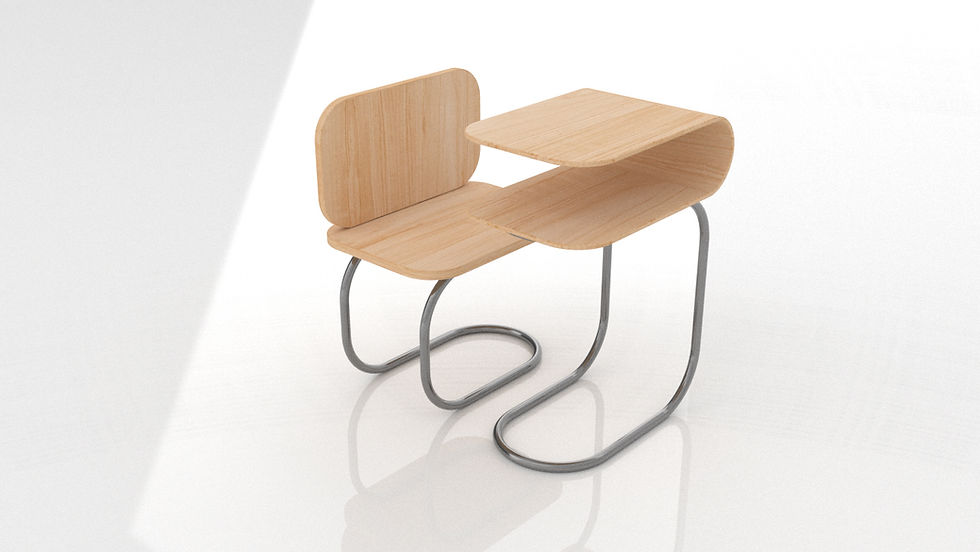


Students can easily rearrange benches for individual or group activities, creating dynamic learning layouts.
Two units can be joined to form a larger shared bench, fostering collaboration and interaction.
A 1:5 scale prototype was developed to test stacking efficiency, comfort, and ergonomics. The plywood form and tubular base proved lightweight yet stable, making it easy for students to lift and reposition as needed.
Reflection
Stack-a-Seat reframes classroom furniture as a flexible learning tool, not a static object.
The design highlights how small-scale spatial interventions can foster collaboration, comfort, and student autonomy—demonstrating the potential of physical systems to influence educational engagement.
Project Summary
Focus: Human-centered research, modular design, behavioral insight
Role: Designer–Researcher
Methods: Interviews, prototyping, ergonomic testing